This tutorial is a continuation of How to Draw the Head from Any Angle. I will go over the structure of the eye and detailed information on drawing the brow ridge, eyeball, eyelids, eyelashes, iris, cornea, and pupil.
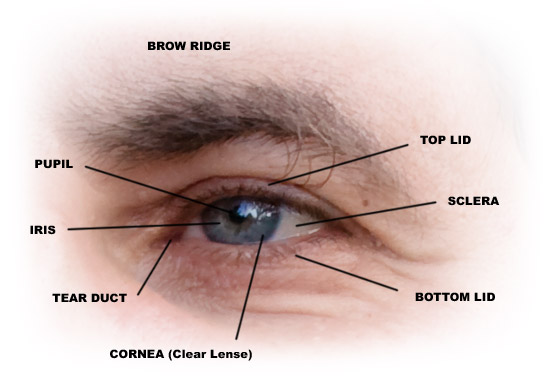
The Basic Forms
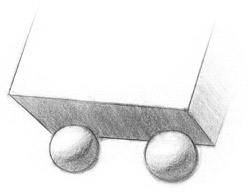
As with the head, it’s important to understand the basic structure of the eye and the brow ridge. The brow ridge can be simplified to a box tilted back slightly. The front plane of the box represents the forehead and the bottom plane represents the plane directly beneath the eyebrows. The eye itself is a simple sphere that sits under this box. |
The Eyeball
The part of the eyeball that is visible (technical term is Sclera) is commonly called the ‘white of the eye’. However, a common mistake is to literally make it white. The eye ball is a round volume and it needs to be shaded like one. Depending on the light source, usually a gradient on one side or both will do the trick.
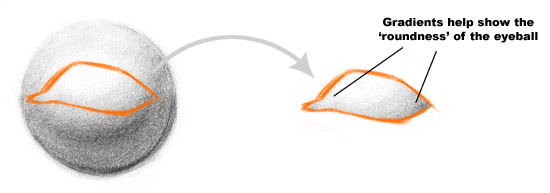
The biggest mistake you can make is to leave the ‘white of the eye’ white, when the entire eye is in shadow. That makes it look as if the eye is glowing. Not good…
The Iris, Cornea, and Pupil
Structure of the Iris and Cornea
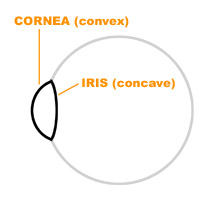
![]() The iris and cornea sit on the eyeball like two bowls. The iris is a slightly concave bowl (like a crater) and the cornea is a convex bowl (like a hill). The cornea is much like a transparent contact lens, so the iris and pupil are visible behind it. The shape and angle of the iris is commonly overlooked. It will only be a perfect circle from front view. When the eye moves around, the shape becomes an oval and the angle changes depending on the direction of the gaze: |
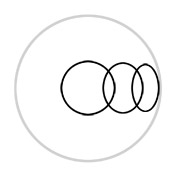
![]() The further the iris is from center, the narrower the oval will become. |
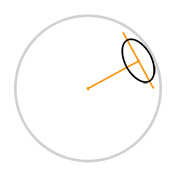
![]() To find the angle of the oval, draw a straight line from the center of the eyeball to the iris. The angle will be perpendicular to this line. |
The Pupil
It’s important to remember that the pupil is on the iris, not the cornea. In fact, the pupil is a hole in the iris that lets light in. The pupil dilates to let in more light and contracts to let in less light. So, when drawing the pupil from a side angle, be sure to draw it on the iris.
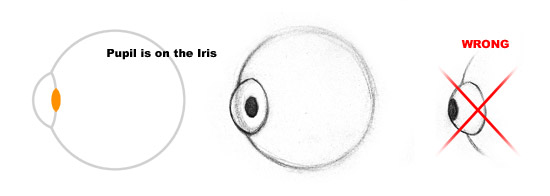
Shading the Iris, Cornea, and Pupil
Understanding the structure of these forms is important for when you start shading them. The pupil is easy. Its always a black dot on the iris. When we describe the color of someone’s eyes, we are describing the color of the iris. The iris must be shaded like a concave form. If the light source is from the top, the bottom of the iris will be lit. If the light source is from the left, the right side of the iris will be lit, and so on… The cornea will be the exact opposite, because it is a convex form. This is easier to understand with an image:
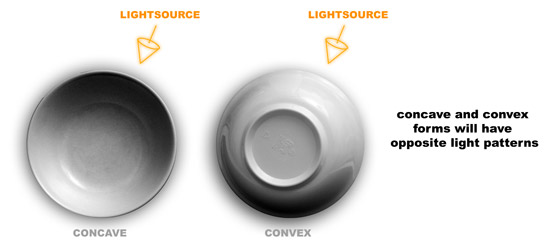
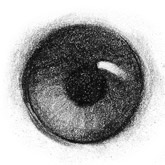
![]() Since the cornea is transparent, the only part that will be visible is the highlight. So, an easier way to remember all this is… The highlight on the cornea will usually be on the dark part of the iris. |
The Eyelids
Eyelids Are Not Flat
![]() Try not to draw the eye lids as if they are flat on the face. The eyelids must wrap around the eyeball. Think of two beanies on a soccer ball. |
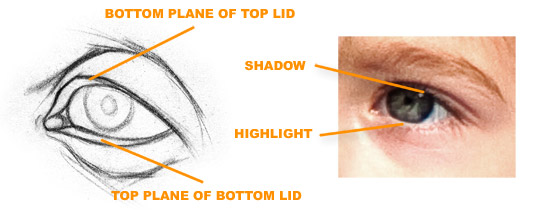
Also, the lids have some thickness to them, so showing the bottom plane of the top lid and the top plane of the bottom lid is very important. If the light source is above the eye, as it usually is, the top lid will have a shadow on its bottom plane and the bottom lid will have a highlight on its top plane.
The Shape of the Eyelids
The shape of the opening between the eyelids is one that confuses most of us at one point or another. It’s complex and it changes as the eye moves. From the front, in a relaxed position, it looks something like this:
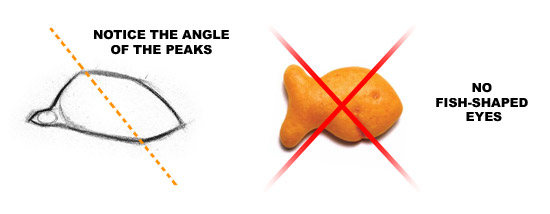
Notice the angle of the peaks. The top lid peaks closer to the nose, while the bottom lid peaks closer to the ear. Do not draw a generic goldfish cracker. The tear duct shape also adds some complexity. It is not centered between the lids, but is a bit lower towards the bottom lid.
From the side, the shape resembles a triangle with the cornea poking out. The tear duct is hidden at this angle since it is behind the eyeball.
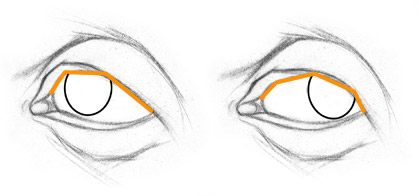
Another factor that will change the shape of the lids is the cornea. Since it is a convex form, as the cornea moves it will push the lids out. Notice how the shape of the lids changes as the eye moves.
Eyelashes
The trick with eyelashes is to simplify them. I like to group them together into chunks and draw them as simple dark shapes. From the front, the dark shape of the lashes will merge with the dark shadow under the top lid. If the lashes are long and curl up enough to be seen as individual lashes, still try to simplify them rather than drawing each lash. I like to draw them blurry as if they are out of focus. From the side, the shape is like a curly triangle.
The Brow Ridge
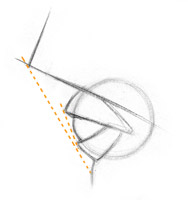
The brow ridge acts like an awning to protect the eye. Similarly, the top lid extends forward further than the bottom lid.
The eyebrows sit on the brow-ridge and peak towards the outer end. The outside ends tend to be lighter, thinner, and have less hair than the inside ends. The shape of the eyebrows varies from person to person. Men tend to have fuller and straighter types while women have thinner types that peak higher. |

* * *

Related tutorials: How to Draw Lips, How to Draw the Nose and How to Draw Ears
Email to a Friend
Get Email Updates: Don't Miss New Tutorials


As with the head, it’s important to understand the basic structure of the eye and the brow ridge. The brow ridge can be simplified to a box tilted back slightly. The front plane of the box represents the forehead and the bottom plane represents the plane directly beneath the eyebrows. The eye itself is a simple sphere that sits under this box.


The brow ridge acts like an awning to protect the eye. Similarly, the top lid extends forward further than the bottom lid.
50 Comments:
Thanks Stan, That was helpful!
Eye give you an A for awesome!
This is very cool. The tutorial breaks down one of my greatest challenges drawing the human face.
Thanks!
Thank You, Stan. And thanks to Beverly for sharing. Miss all of you!
Best Regards
Fernanda
Thanks for the great tutorial, I learned a lot of things that I didn’t know before. I like your sense of humor.
Great tutorial! Very detailed and easy to understand. Thanks!
A wonderful tutorial, both easy to understand yet thorough! It has helped me to understand where I was going wrong, thank you =]
I’m glad you guys are learning. If anyone has requests and ideas for future tutorials, please email me or comment.
wow that was easy to understand and it pointed out were i was going wrong that was so easy because it was a visual tutorial and showed real life things. thanks
Love it! with a pasion!
Thanks!
Thank you. Thank you. Thank you.
Thank you this was very helpful. I thought I was very good at drawing eyes until I read this and figured out I was doing everything you said not to do. I’m really impatient and wish I could become an artist overnight, but this was simple and easy to understand. I do have one suggestion though. You might want to remind the reader about what convex and concave mean. Sometimes I had to scroll up to see which was which. On the other hand most people know what that means already, so it’s your choice, I’m just a middle schooler. Anyway, fantastic explanations and thank you fo this article.
Thanks Skyler!
remember, concave goes inward like a cave.
I an very grateful to you as you helped me in various steps of drawing where I have never seen any mistake by myself so thank you so much I shall more grateful if I can get tutorial via email when need be thank you
Ashley. Thank you! If you would like to be notified by email of new content add your email address to my mailing list. You can find the mailing list link at the top right of this website.
cool techniques and a beautiful eye!
Great posts Stan - and thanks very much for sharing your knowledge and helping other artists. I have been struggling with self-portraits for a while now and now begin to see why. I will read all of your articles about the head and face and go back to the easel with a renewed confidence.
Regards
How to draw eyes is nice tutorial for drawing eye images.
Thank you.
Edit
awesome thank you for writing this!! SOOOO many helpful hints
Thank you very much!!! wonderful for me…this draw help me a lot
Great tutorial.Thanks
an excellent lesson in depicting the eyes which indeed are so crucial in holding the beholder…. I just love it and would love to have more tips and guidance notes
my best
Kiran Soni Gupta
http://www.kiransoniarts.com
Very good! I have been drawing mostly faces for more than 35 yrs and I learned something from this.
This is another awesome tutorial. One thing I think might be useful though is some commentary on the size of the eye with respect to the head, especially regarding the sphere around which one draws the eyelids.
Thanks for putting these up–very useful!
Thank you very much Stan. Your “how to tuts” are so GREAT, thanx for sharing, Ivana.
I have googled “how to draw eyes” and have studied lots of sites with different techniques, but your explanation is by far the best I have seen. Thanks so much!
Very nice tutorial. You’ve managed to compile a set of guidelines that I’ve never seen so succinctly and thoroughly presented in one spot before. I would have killed for this about a month ago when I picked up my pencil again after a long, long hiatus. I’ll value it highly now. Thanks!
Wow, that was really good. It’s easy to understand and also all the information about the shape of the eye helps alot. Thank you so much!
I think it’s most particular explanation that i had ever read
all this is very important to learn how to draw a really eyes.
Stan, I have looked at dozens of how-to-draw sites in my quest to learn about drawing the eye. Yours is by far the clearest. I finally understand that the cornea has a pushing effect on the shape of the lids - something I’d observed from life but never seen so clearly described. And I didn’t realize the cornea was concave, but knowing that has made a huge difference to the realism of my drawings.
Thank you!
Thank you! That was really simple to follow, and really useful!
Mind blowing!. :). thnx.
Very good.
This was such an effective way of teaching. It really helped me and I have been drawing and teaching drawing to high school kids forever. I think it was because of the fun stuff that you use to help to relate to what info you had to get across like the beanies and the goldfish and the saucers. Kudos. Can’t wait to see your other step processes. Is it okay to share this with my students once we go back to school in the fall?
Very good tutorial. It is cool that so much could be known about eyes just from an artistic rendering viewpoint. Good stuff.
I love this tutorial — it helps a lot!
Thanks!
Wow thank you so much Stan. Opened MY eyes to some things the concave and convex or retina and cornea yea and all the other awesome clarity you filled in between the dots.
excellent,like most good teachers, you take a complex subject and simplify it so us mear mortals can begin to understand.I learned more about drawing the eye from your lessen than I ever learned in high school. thankyou
im not going to use this tutorial in any way… but i do want to say that it was extremely well done… i glanced over it… the diagrams gave it all away and when i went to read it, I pretty much knew it all! Great work!
You asked if we had suggestions for future tutorials. First I have to say, I love your tutorials; clear, simple, direct and easy to follow. My next challenge is bringing all these pieces together. How do you instill emotion or character into the face?
Ur on stumble so prepare for the onslaught of comments!
This was enormously helpful! Thank you!
wonderful information. Love the way you illustrate form thru examples like beanies on the soccer ball. Looking forward to learning more from you!
Thank you for the infomation. I especially love portraits. Your information is well written, informative and yet still easy to understand. You wrote of a few things I have not considered or read before. It’s always fun to learn something new.
this was pretty good, I learned a thing or two
angela - yes it’s ok to share!
thanks everyone! I’m glad the tutorials are helping!
I am not really one who draws, but this seems like it might be a fun tutorial to try. Definitely worth a SU thumbs up.
Your tutorials are really helpful! The ideas you use for conveying the concepts, like the soccer ball and the concave and convex plates are perfect. I hope to see more tutorials soon. Thanks.