When you venture into the confusing world of painting, one of the first things you need to put some thought into is your studio space. Working in a poor environment can really hurt your performance.
My Ideal Art Studio
One of my big dreams and goals in life is to have a gigantic art studio to brag about. Here’s my vision of the perfect art studio.
- North light coming from above and plenty of artificial light for painting at night
- High Ceilings
- Enough space for a model stand, large easel arrangement, library, area to keep all the supplies and artwork, a couch, fridge, and a Nordstrom pianist.
- Large monitor next to my easel for reference.
- Far away from any noise and distraction
- Lots of wall space to hang inspirational artwork
- Ventilation
- Surround Sound Audio System
For now, most of us have to work with limited space and funds. If you don’t have the luxury of a large room to setup your art studio, you’ll have to get creative and work with what you’ve got.
“But I don’t even have enough room to put my easel!” You’re gonna have to make some sacrifices. Ever think about selling your TV (use the money for some art supplies) and using that space for your easel? Try to do as much as you can with the resources you’ve got. If you’re really serious, you will find a way! Most of us have to adjust and adapt to what’s available in our house/apartment, but there’s a few important things to think about when setting up an art studio: properly lighting the studio and the placement of your reference photos.
Properly Lighting the Studio
For the longest time, I painted in a room with warm light bulbs and a south-facing window directly behind me. Even if the window is facing north, that’s probably the worst lighting you can have, excluding complete darkness. Any kind of light source behind you will reflect in the painting. I used to always be able to see my own silhouette in my paintings. Ideally, you want north light coming from above.
Why north light?
That way, you never get direct sunlight coming into the room. If you setup a still life or a model in the studio, the lighting will stay somewhat constant throughout the day. If you have direct sunlight coming in, the lighting will change as the sun moves. You don’t want any direct light hitting the canvas either. This creates very strong highlights on the paint and can be very distracting. The white of the canvas and the palette will reflect the sunlight and cause glare. Too much of this UV exposure can’t be good for your eyes! Plein air painters experience this ’snowblindness’ a lot when not painting in the shade. North light is very soft and bounces around the walls of the room to illuminate everything evenly.
Why from above?
Because you don’t want any distracting reflections in the painting. Think of the painting as a mirror. The wet paint will reflect any bright objects behind you. It might even be a doorway with some light coming in. You can have north facing windows that are not up high, but you’ll need to face the easel away from the windows and add some artificial light.
If Needed, Add Artificial Light
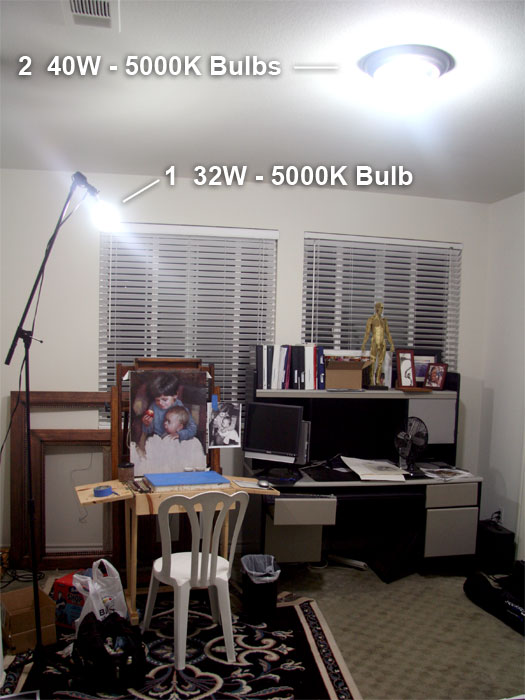
*Click to Zoom
It’d be nice to have high north facing windows, but most of us don’t really have a choice where our windows are. So, what do you do when you have south facing windows or windows that aren’t high up?
South facing windows
I say close them completely to get rid of the sun. Get some nice curtains and use artificial light.
Low north facing windows
This is what I have in my art studio. I turned my easel to face away from the windows. I don’t want to see the reflection of the windows in my painting. In addition, I added some artificial light.
Adding Artificial Light to the Art Studio
For more information about light bulbs, read my tutorial on Choosing a Light Bulb for Your Art Studio. Currently, I’m using some heavy duty CFL bulbs with a total of 112 Watts and 5000 Kelvin color temperature. Like windows, the bulbs have to be elevated above the easel to prevent seeing the reflection in the painting. They should be far enough from the easel as not to create a hot-spot on the canvas. Table lamps or lamps that clamp on to the easel don’t work very well. My current setup works great for me whether I’m painting in the morning, afternoon, or late at night.
I bought my bulbs at 1000Bulbs.com. They have CFL’s ranging from 2 to 200 Watts, with a good CRI rating, 5000K color, and great prices.
Placement of Reference Photos
*Click to Zoom
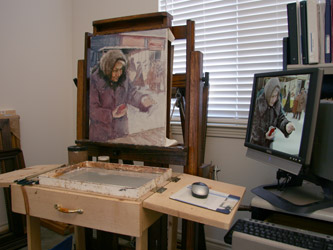
Try to keep your reference close to the painting to easily compare the two. Also, make sure the reference is angled directly at you to prevent perspective distortion.
Using printed photos works fine, but I prefer to paint from my monitor for several reasons:
1. Quality
For the same reason that making a copy of a copy isn’t as good as the original, printing the photos isn’t as good as working from the monitor. Every time you convert the information from one media to another you lose quality and detail. Working from life is the best reference, but most of us don’t have that privilege, so we convert life into a photograph and we lose a little bit of quality. Then if you decide to print the photograph, again you lose a little bit of quality. Depending on how good your camera and printer is determines how much quality we lose from the original source (life).
2. Convenience and Organization
Sometimes I have multiple reference photos that I use to composite into one painting. On my computer, I can easily switch from photo to photo as I need to. I don’t need to hang all the photographs around my easel.
3. Zoom in and out
When needed, I can zoom into a specific area I’m working on and get even more detail. I only use this in areas where I want to get a lot of detail such as the head and hands. I try to avoid this in background elements because its very easy to get caught up in all the details.
If you can’t work from a monitor, then make sure you use high quality photo reference. Kinko’s has self service stations where you can print color photos 8.5 x 11 for about $1.
Read on… Choosing a Light Bulb for Your Art Studio
Email to a Friend
Get Email Updates: Don't Miss New Tutorials


19 Comments:
hi stan, if you have north light coming in the studio from large double doors as the natural light source, should i then have my easel faced away from the windows, in other words, as I paint, I would face the windows and then have a cool lamp positioned from above, also, should I put cool lights in a couple of my ceiling lights, and if so, what type have you found successful for canned ceiling lights. Thanks for the tips and help!
PS Nordstrom pianist couldn’t handle the howls from my dogs, so I opted for my MacBook iTunes surround sound laptop…
some would say you are a smart %&*&(!
smile!
Beverly - Yes, definitely face away from the doors and add some artificial light. Try to get a full spectrum bulb (CRI as close to 100 as possible) with a white balanced color temperature (not too cool or too warm, about 5000K range). Also, make sure it is bright enough (I think 400 Watts total of all the bulbs is enough). I like to use Compact Fluorescent Bulbs because they save energy. 42W CFL is equivalent to 200W bulb. I’m doing some research now to find a perfect bulb. As soon as I find something, I will post it.
[update] - I’ve posted a tutorial on How to Choose a Lightbulb
I found this to be very informative. I always worked from photographs and sometimes found it difficult to pick up detail. I will definately try using the computer. Thank you.
I found this to be very helpful. I am just starting to paint again after 20 years. I have a studio with horrible lighting and my years aren’t that good to begin with so thank you for these wonderful tips, very helpful.
Choie Wells
Hi Stan,
I have been enjoying your site very much. The information has been invaluable in setting up my lighting for my new studio. I have a basement studio that my husband and I have been working on for a month. The room has two glass block windows, so I will definitely need good artificial lighting. I can’t tell from your photo, but is your ceiling lighting fixture covered or is it just bare bulbs? If it is covered, what kind of covering is best. Thanks for your help.
Karen - my ceiling cover is glass. I’m not sure what the best kind is but make sure that it doesn’t block too much light and it doesn’t shift the color of the light. If it does, then it’s better to just leave it uncovered.
I’ve just discovered you and your web site. As someone who has put off doing art for years, I’m thrilled that this wonderful resource is available to anyone willing to make use of it. It’s very generous to share your knowledge.
I first found your work at a the Julian Art Gallery. It is truly inspirational.
Thank you: Kay
Stan, Thank you for your great web site. I have a question: north light from above. Is that high windows on a wall or a sky light? We’re remodeling and I’m creating a painting studio. the house to the north of ours is very close and higher, so will block light from north windows. I’d like to find out if a sky light would work for my painting studio which will be on the northeast corner of the house. I paint in oils.
Many thanks, your information is so helpful. Lana
Lana,
Skylight should work, as long as it’s big enough. I would still have a good artificial light setup for cloudy days and when it’s dark out.
Hi- What makes a good flooring in an oil studio? I’m wondering about clean-ability if paint splatters, a brush drops, solvent gets knocked over etc. I currently have carpeting in there but would like to change it. Tile is not a likely option. But for those who have carpet- is there something other than a tarp that makes a good floor protection? Thanks.
Liz,
My solution to that was a descent looking, cheap rug that I don’t mind getting dirty. You can see that in the first picture on this page.
If you’d like to change your carpet I’ve always liked wooden flooring. If you drop paint you can clean it very easy as long as you don’t let it dry. I would still have a rug at the work area though…
Liz,
I just completed my studio a few months ago and used anti-fatigue interlocking (puzzle) rubber/foam? flooring, sometimes called mats. They come in boxes or packages that cover so many square feet. You purchase how many boxes you need–plus extra to replace if you damage or ruin an area. I bought mine at Costco. I’ve used mainly acrylics, watercolors, waterproof inks & charcoals since I installed them, I intend to use my oils in my studio too. They are great to stand on, because I have concrete underneath. They also clean up very nicely and are easy to keep clean.
Just found your web site. Thank you so much for sharing this information. I’m in the process of setting up my painting studio and looking for organization ideas. (I’m not such a person) I like to work with everything available at my fingertips and be able to enclose it when I’m done. Also, a good way to store canvases in many sizes. Any suggestions? Thanks again for your thoughts.
Hi Stan,
This blog post was really informative!
Question - what kind of lamp is the free standing light in your studio picture? The one that you indicate has a 32W - 5000k bulb? I would like to buy a similar kind of light but am not having luck in my Google searches. Any direction you could offer would be greatly appreciated! Thank you!
Hi- I was wondering what size monitor you are using. I have painted from a monitor very successfully in the past but no longer have a large monitor. All I have is my laptop and feel that the screen is too small. Thanks for the good information.
Sherry, I also find it difficult to paint from a small laptop. I currently have 2 monitors both 21 inches. Two monitors allow extra room for supporting reference.
hi http://www.stanprokopenko.com-ers happy christmas to all of you - matt-mays
we just moved in to our new home, i now have a room with high ceillings and great north light , still working on the lighting ,i live in the north west and its purty dark this time of year, but i am very excited to get to painting agine. Happy painting to you and yours .Connie A PS . like your site.